Writing Against Semantics

"(...)[Roland] Barthes wrote: 'Language is never anything but a system of form, and the meaning is a form'. So a resistance to meaning itself is called for—to meaning's claims to be natural, and consequently to be the rock-solid foundation on which our collective lives are built".
- Peter Schwenger on "Asemic: The Art of Writing"
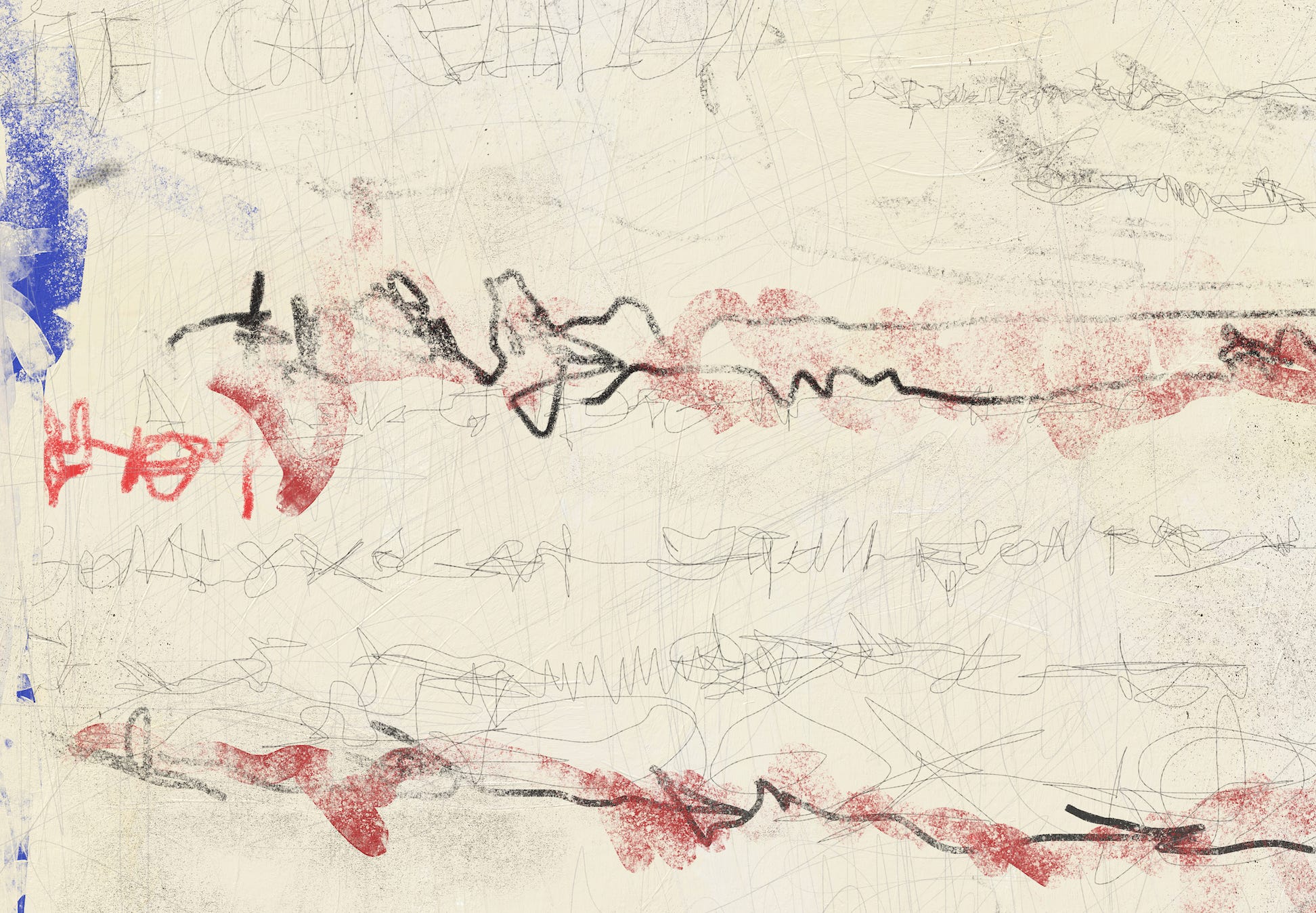
Abstraction is a language, one that speaks and writes in a syntax that is foreign to us, yet completely understandable. The movements of a brush imprinted on a canvas, or of a digital pen on a digital file, the messiness of paints interacting with one another, the surfaces broken, rebuilt, remodeled, erased. This raw material finds its ways into the mind, building meaning from a state of unknowingness; it's a universal language engraved deep into our unconscious.
Some recent works of mine display a recurrent interest in language, its limitations and how much our comprehension and absorption of reality is affected by linguistic and syntactic preconceptions as well as the attachment to meaning, to a purely functional approach to the characters and to writing in an era where we mostly type out sentence after sentence, the gesture of writing taking a different role from what it once was.
Building upon the relationships between painting and writing, asemic writing exists as an alternate path to expression that defies and subverts the logic of language as it is mostly understood by removing the layers of meaning and communication that sit atop writing, leaving only the raw gesture of writing exposed. Roland Barthes said that "Nothing separates writing (which we believe communicates) from painting (which we believe expresses): both consist of the same tissue". By removing the purely communicative function of writing, we shed light onto something different. Instead of seeing the message, seeing what the writing means, we are able to see the writing, much like relinquishing a figurative approach to painting lets us see painting. Barthes goes further into the idea by claiming that "for writing to be manifest in its truth (and not in its instrumentality), it must be illegible", a claim that echoes a relationship built with abstract painting, as a means to reveal its truth, to say at the same time nothing and everything through its illegibility.
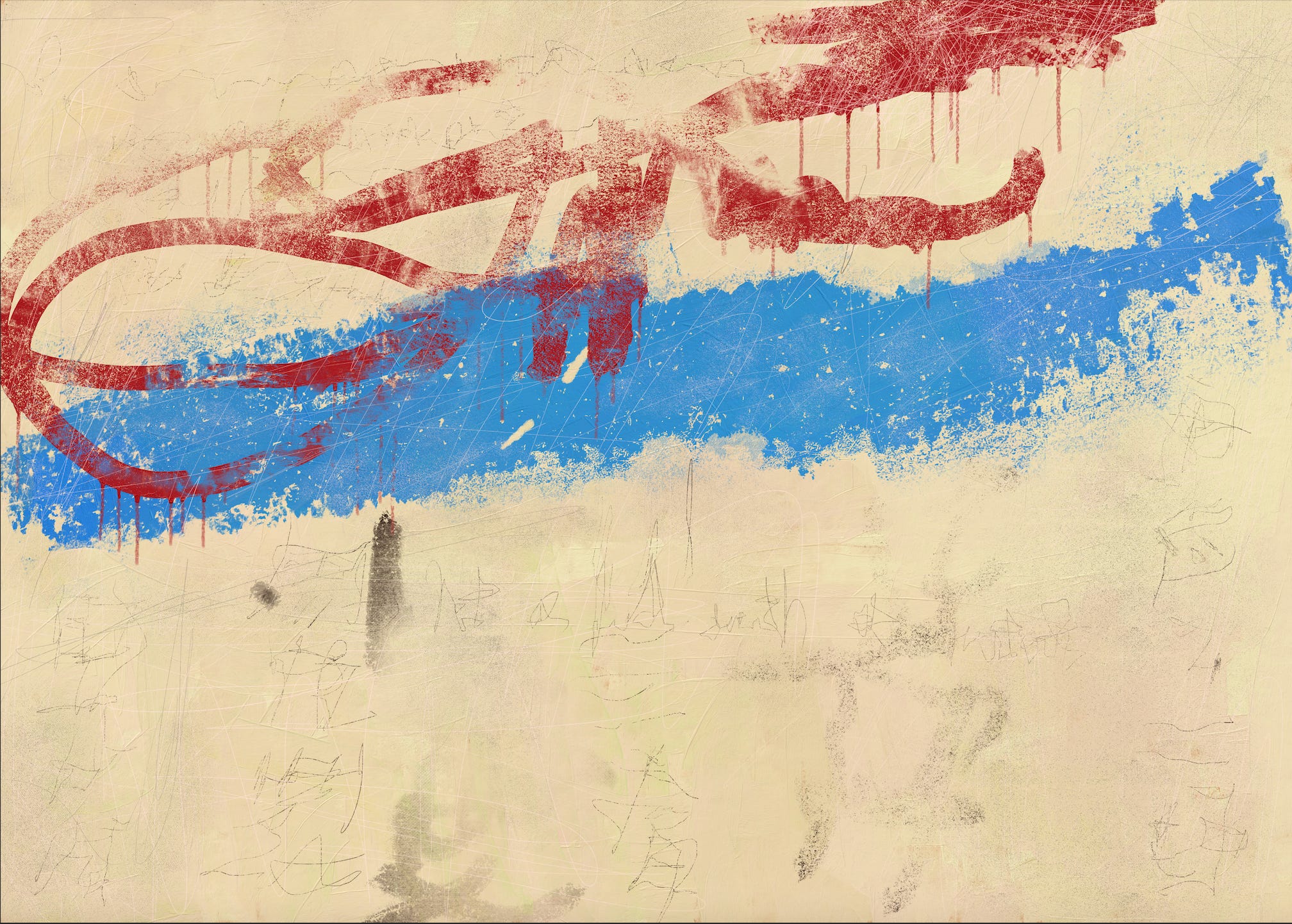
Chinese written language takes a different approach to the experience of writing, as it does not rely on using characters to create syllables and represent phonemes that concatenate to build words in the way that western languages work. Instead, its characters represent words, concepts and ideas, making the reading of Chinese scripture a singular and subjective experience, given that there is very little grammar present and has no verbal inflections- not being able to differentiate nouns and verbs and adjectives and so on without a context. Freud in Introductory Lectures On Psycho-Analysis says the Chinese language
(...) consists, one might say, solely of the raw material, just as our thought-language is resolved by the dream-work into its raw material, and any expression of relations is omitted. In Chinese the decision in all cases of indefiniteness is left to the hearer’s understanding and this is guided by the context.
Drawing inspiration from these alternate approaches to language, I've been seeking to unite the painting, the writing, the meaning and the lack thereof as a challenge and a subversion of language and the ropes of consciousness and utilitarianism that tie into it. Using strategies such as using my non-dominant hand, I want to avoid muscle memory habits and writing "right", to be like Barthes wrote about Cy Twombly's scribbles, a "kind of a blind man: [Twombly] doesn't quite see the direction, the bearing of his gestures; only his hand guides him, or that hand's desire, not its instrumental aptitude". The meaning becomes irrelevant as the body gesture turned into something outside the body conveys meaning that bypasses the rational centers of the brain. The writing becomes the protagonist and semantics are no longer needed.
I want to challenge the traditional role of language as a means of communication and instead invite the viewer to experience the raw, expressive power of writing and painting. Inviting us to consider the ways in which our preconceptions and attachment to meaning can limit our understanding and appreciation of art, and encourage us to explore the deeper, unconscious layers of expression. I'm using writing as a weapon against the word.
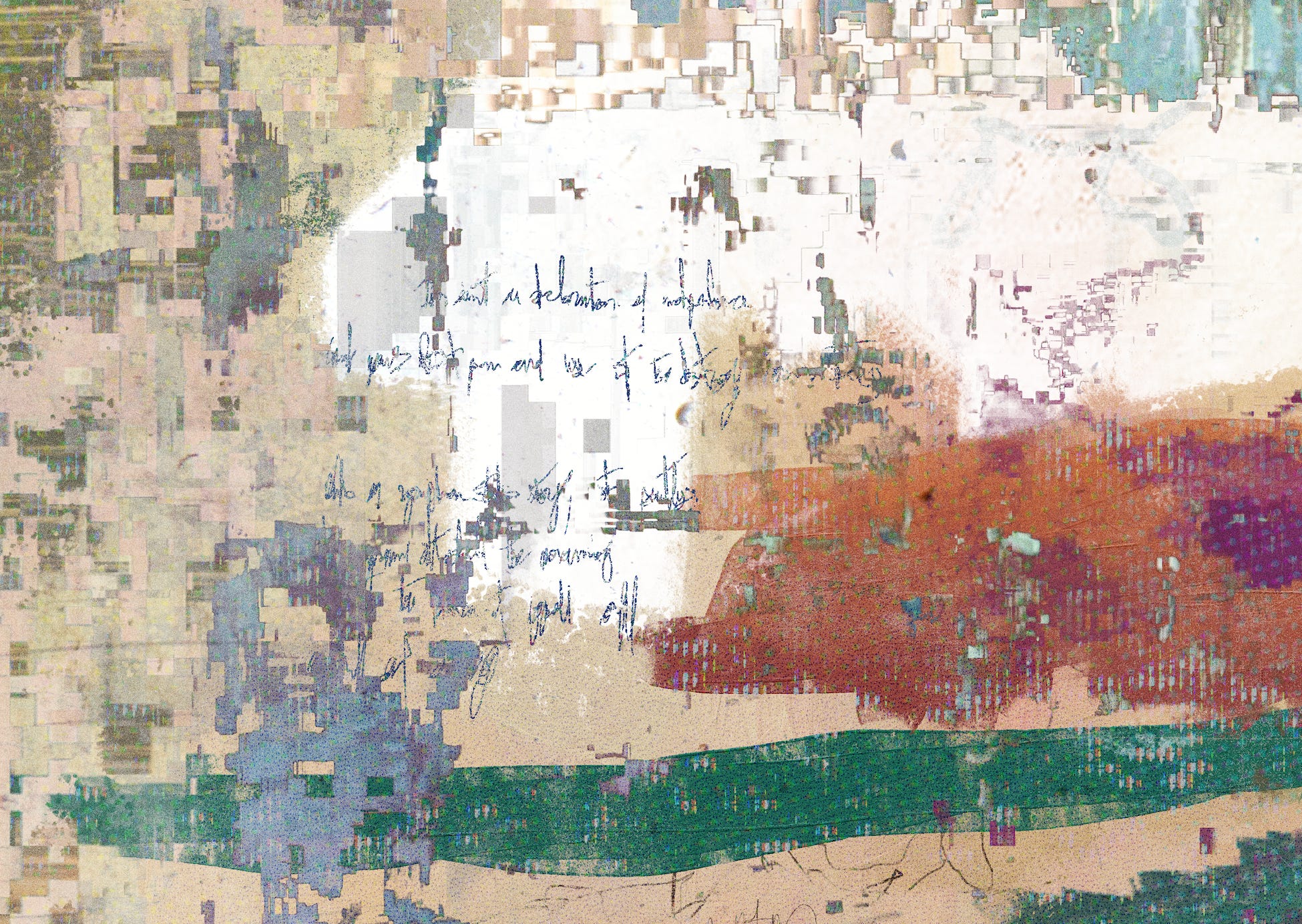
This is the adaptation of a text that started out as a statement for a specific body of work, but in the end, it merged so deeply into my practice that it cannot be restricted to one specific series. This is an essential element of what I seek in making art, how I create my inner world and how I connect with the outside world.
Words are words upon words.